
Skip to content
Orthodontics

Clear Aligners in Hyderabad

A sequence of clear removable trays that shift teeth gradually, with small attachments bonded on which are going to be of the same shade of the tooth.

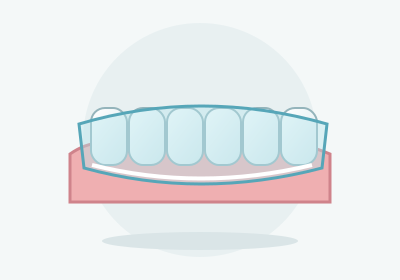
Transparent aligner tray fitted over teeth
Clear AlignersOrthodontics
Reviews every 6–10 weeks
None needed
Appointment
Each tray worn 1–2 weeks
Visits
Reviews every 6–10 weeks
Anaesthesia
None needed
Recovery
Mild tightness for 1–2 days with each new tray
How long it lasts
Stable long-term if retainers are worn as directed

Overview

What are clear aligners?

Clear aligners are a series of transparent trays, each moulded very slightly differently from the last. Worn in sequence, each one nudges the teeth a fraction of a millimetre closer to the planned position.

The whole sequence is designed up front from a digital scan, so you can see the projected outcome before you start. They come out for meals and brushing, which is their real advantage — and the reason they only work if you actually wear them.

Suitability

Is it right for you?

Aligners may suit you if

  • Your crowding, spacing or rotation is mild to moderate
  • Being seen in braces is a concern at work or socially
  • You will genuinely wear them 20–22 hours a day
  • Your gums are healthy
  • You want to eat and brush without working around brackets

Your other options

  • Fixed braces — more reliable for complex cases, and not dependent on your wear time
  • Ceramic or lingual braces, if the concern is purely visibility
  • Veneers, which mask mild misalignment cosmetically but do not move anything
  • No treatment, for mild crowding with a healthy bite

If one of these suits you better than clear aligners, we will say so at your consultation — including when the right answer is to do nothing for now.

Options

How we plan aligner treatment

  • Digital scan and simulation

    An intraoral scanner replaces impressions. You see a projection of the movement before committing.

  • Full-arch treatment

    The complete sequence for both arches — the usual case.

  • Limited / anterior alignment

    A shorter sequence correcting only the front teeth, where the back bite is already sound.

  • Attachments and refinement

    Small tooth-coloured bumps bonded on to the tooth give the tray grip for harder movements, plus a refinement sequence if teeth do not track exactly to plan.

  • Aligners with a fixed phase

    Some cases start with brackets for the difficult movements and finish with aligners. We will say so if that is what your case needs.

Step by step

What actually happens

  1. Step 1: Assessment and scan

    Visit 1

    Photographs, X-ray and an intraoral scan. We will tell you honestly whether your case is suited to aligners.

  2. Step 2: Digital plan

    1–3 weeks

    The movement sequence is designed and simulated. You review the projected outcome before we manufacture.

  3. Step 3: Fitting the first trays

    Visit 2

    Attachments are bonded where needed and we check the fit. You are shown how to seat and remove them.

  4. Step 4: Wearing the sequence

    Ongoing

    Change to the next tray every one to two weeks as directed, with a check-in every couple of months.

  5. Step 5: Refinement and retainers

    At the end

    A short refinement run if anything has not tracked, then retainers.

Benefits

Why it is worth doing

  • Near-invisible in normal conversation

  • Removable for meals — lesser food restrictions

  • Brushing and flossing are unchanged

  • Fewer chair visits than fixed braces for most cases

  • No brackets to rub the cheeks, and no emergency loose-wire visits

After treatment

Recovery, aftercare and risks

Recovery and aftercare

  • Wear them 20–22 hours a day. Below that, treatment simply stops progressing
  • Take them out for anything other than room temperature water — hot drinks warp them and coloured drinks stain them
  • Rinse and clean the trays daily; never clean them in hot water
  • Keep them in their case, not a napkin — a napkin is how most lost trays are lost
  • Wear your retainer as directed once you finish

What can go wrong

  • They only work if worn. Poor wear time is the most common cause of a disappointing result, and it is not something we can compensate for
  • Complex rotations, large gaps and significant bite correction are beyond what aligners reliably achieve
  • Attachments make the trays more visible than the marketing suggests
  • Speech is affected for a week or so at the start
  • Teeth relapse without retainers, exactly as with braces

Who will treat you

Our clinical lead

Dr. G. Vijay Srinivas

MDS · MNDC (New Zealand) · MADC (Australia) · PGDAI (CIIOMFI, France) · Fellow ICOI (USA)

Dr. G. Vijay Srinivas is an Oral & Maxillofacial Pathologist and Implant Dentistry practitioner with more than 35 years of clinical experience, and the founder of AP Superspeciality Dental Hospitals.

Full profile

Where

Hospitals offering clear aligners

  • Banjara Hills Elite

    On Road No. 2, in Park View Enclave — third floor of the HSR Eden building.
  • Banjara Hills

    Beside Centre for Sight Eye Hospital on Road No. 2.
  • Suchitra 'X' Roads

    Beside Suchitra Academy, fifth floor of Jain Friends Square on Suchitra Road.
  • RTC 'X' Roads

    At RTC 'X' Roads in Vivek Nagar, off the Chikkadpally main road.
  • Vijaynagar Colony

    Opposite the Hockey Ground on Vijay Nagar Colony Road, near Masab Tank.

Questions

Clear Aligners — your questions

Still have questions?Call or message us — we reply quickly.Call a hospitalWhatsApp

Typically 10 to 24 months depending on how far the teeth need to move. Minor front-tooth corrections can finish in under eight months. The figure assumes you wear them as directed — at 14 hours a day instead of 22, the timeline stretches or the plan stops working.

Close to it, but not entirely. The trays themselves are clear and hard to notice in conversation. The attachments — small tooth-coloured bumps bonded to some teeth to give the tray grip — are visible up close. Honest answer: far less noticeable than braces, not literally invisible.

Each new tray feels tight and the teeth ache for a day or two, then it settles. Most patients find it milder than a braces adjustment. The edges can occasionally rub the tongue.

It depends on what needs moving. Mild to moderate crowding, spacing and mild bite correction — usually yes. Severely rotated teeth, large gaps, significant jaw discrepancies — usually not, and we will say so rather than start something that will not finish well.

Go back to the previous tray immediately and call us. Do not skip ahead to the next one — that forces movement the teeth have not been prepared for. We will arrange a replacement.

Book about clear aligners

Prefer to talk? Call 888 605 2345 or find your nearest hospital.

Book your appointment

Message us on WhatsApp or call your nearest hospital and we will find you a time.