
Skip to content

Root Canal Treatment in Hyderabad

Clears infection from inside the tooth so it can be kept rather than pulled out.

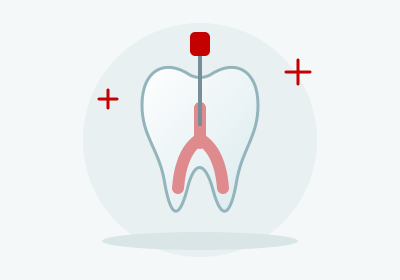
Illustration of treatment inside the root canals of a tooth
Root Canal
1–2 visits, plus a crown
Local anaesthetic
Appointment
30-45 minutes per visit
Visits
1–2 visits, plus a crown
Anaesthesia
Local anaesthetic
Recovery
Tenderness for 2–4 days
How long it lasts
Typically 10–20 years, longer once crowned

Overview

What is a root canal?

Inside every tooth is a soft core of nerve and blood vessels. When decay or a crack lets bacteria reach it, that tissue becomes infected — which is what causes the throbbing, the sensitivity to cold & heat, and eventually an abscess.

A root canal treatment removes the infected tissue, disinfects and shapes the canals, and seals them. The tooth stays in your jaw and keeps working. It is the alternative to extraction, and keeping your own tooth is nearly always the better outcome.

Suitability

Is it right for you?

You may need a root canal if you have

  • Persistent toothache, especially one that wakes you at night
  • Lingering pain after something hot or cold, rather than a brief twinge
  • Pain on biting or when pressure is applied
  • A swollen or tender gum, or a small pimple-like spot beside a tooth
  • A tooth that has darkened compared to its neighbours
  • Deep decay or a crack reaching the nerve, sometimes with no pain at all

Your other options

  • Extraction with no replacement, which allows drifting and over-eruption of the opposing tooth
  • No treatment, which is not really an option — the infection will spread and can become a serious facial infection

If one of these suits you better than root canal, we will say so at your consultation — including when the right answer is to do nothing for now.

Options

Various types of endodontic treatment

  • Single-visit root canal

    Completed in one appointment where there is no active abscess.

  • Multi-visit root canal

    An antibacterial dressing is left inside between visits when infection is significant.

  • Re-treatment

    Reopening and redoing a previous root canal that has failed or re-infected.

  • Apicoectomy

    A minor surgical procedure to remove the infection & involves removal & sealing of root-end, where conventional re-treatment is not viable.

Step by step

What actually happens

  1. Step 1: Diagnosis

    Visit 1

    X-ray and pulp testing to confirm the nerve is involved and identify which tooth is the source.

  2. Step 2: Anaesthetic and isolation

    Visit 1

    The tooth is fully numbed and isolated with a rubber dam, which keeps saliva and bacteria out of the canals.

  3. Step 3: Access opening

    Decayed portion of tooth is removed and cavity is modified to attain access to pulp chamber and root canals

  4. Step 4: Cleaning and shaping

    Visit 1

    The infected tissue is removed and the canals disinfected and shaped. This is the longest part.

  5. Step 5: Filling and sealing

    Visit 1 or 2

    The canals are filled with a rubber-like material and sealed to stop bacteria getting back in.

  6. Step 6: Crown

    2–4 weeks later

    A root canal treated tooth becomes brittle and will eventually split without a crown. This step is not cosmetic — it is what makes the treatment last.

Benefits

Why it is worth doing

  • Keeps your natural tooth and its root in the jaw

  • Ends the infection and the pain that came with it

  • Preserves normal chewing and stops neighbouring teeth drifting

  • A crowned root-treated tooth commonly serves for decades

After treatment

Recovery, aftercare and risks

Recovery and aftercare

  • Avoid chewing on that side until the crown is fitted — the temporary filling is not strong enough
  • Tenderness to bite for a few days is normal and settles
  • Take painkillers as advised; call us if pain worsens after day three
  • Do not delay the crown. A root-treated back tooth left uncrowned often splits, and a split tooth usually cannot be saved
  • Brush and floss normally

What can go wrong

  • A small percentage of root canals fail and need re-treatment or extraction — canals can be curved, calcified or branched in ways no X-ray fully reveals
  • A file can occasionally separate inside a canal; this does not always affect the outcome but must be disclosed
  • The tooth is more brittle afterwards and can fracture, particularly if the crown is deferred
  • A flare-up of pain and swelling in the days after treatment happens in a minority of cases
  • The tooth may discolour over time; internal bleaching or a crown addresses this

Who will treat you

Our clinical lead

Dr. G. Vijay Srinivas

MDS · MNDC (New Zealand) · MADC (Australia) · PGDAI (CIIOMFI, France) · Fellow ICOI (USA)

Dr. G. Vijay Srinivas is an Oral & Maxillofacial Pathologist and Implant Dentistry practitioner with more than 35 years of clinical experience, and the founder of AP Superspeciality Dental Hospitals.

Full profile

Where

Hospitals offering root canal

  • Banjara Hills Elite

    On Road No. 2, in Park View Enclave — third floor of the HSR Eden building.
  • Banjara Hills

    Beside Centre for Sight Eye Hospital on Road No. 2.
  • Suchitra 'X' Roads

    Beside Suchitra Academy, fifth floor of Jain Friends Square on Suchitra Road.
  • RTC 'X' Roads

    At RTC 'X' Roads in Vivek Nagar, off the Chikkadpally main road.
  • Vijaynagar Colony

    Opposite the Hockey Ground on Vijay Nagar Colony Road, near Masab Tank.

Questions

Root Canal — your questions

Still have questions?Call or message us — we reply quickly.Call a hospitalWhatsApp

The procedure itself is done under local anaesthetic and should feel like having a filling — pressure and vibration, not pain. The reputation comes from the state people arrive in: an infected tooth already hurts badly, and the treatment is what stops it. Expect tenderness on biting for a few days afterwards.

Often one, sometimes two. If there is an active abscess we place an antibacterial dressing and bring you back after a week or two, because sealing a heavily infected canal in one sitting risks a flare-up. Then a separate visit for the crown.

For a back tooth, yes. Removing the nerve and shaping the canals leaves the tooth brittle, and molars take the heaviest bite forces. Root-treated molars left without a crown split at a much higher rate, and a split tooth usually has to come out — which wastes the root canal entirely. Front teeth with small access holes are sometimes an exception.

You can, and it is simpler today. Keeping your own root is nearly always the better long-term outcome.

Commonly 10 to 20 years, and often much longer once properly crowned and kept clean. It behaves like a normal tooth for chewing. What shortens its life is new decay at the margin or fracture from a deferred crown.

Book about root canal

Prefer to talk? Call 888 605 2345 or find your nearest hospital.

Book your appointment

Message us on WhatsApp or call your nearest hospital and we will find you a time.