
Skip to content

Cavity Treatment & Fillings in Hyderabad

Decay removed and the tooth rebuilt, ideally before it ever reaches the nerve.

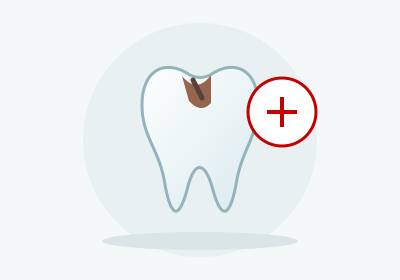
Illustration of decay in a tooth
Dental Cavities
Usually 1 visit
Local anaesthetic for deeper cavities
Appointment
20–45 minutes
Visits
Usually 1 visit
Anaesthesia
Local anaesthetic for deeper cavities
Recovery
Immediate; mild sensitivity for a few days
How long it lasts
Composite 5–10 years; inlays 10–15 years

Overview

What are dental cavities?

A cavity is a hole in the tooth caused by acid from the bacteria in plaque dissolving the enamel. It starts invisibly, does not hurt at first, and only announces itself once it is deep enough to reach the nerve.

Treatment means removing the decayed tissue and rebuilding the tooth with a filling. Caught early it is a twenty-minute appointment.

Suitability

Is it right for you?

You may have a cavity if you have

  • A twinge with sweet, hot or cold food
  • A visible dark spot, hole or pit in a tooth
  • Food consistently trapping in the same place
  • A rough edge your tongue keeps finding
  • Persistent bad breath or an unpleasant taste
  • No symptoms at all — which is the most common presentation, and why check-ups matter

Your other options

  • Fluoride and better hygiene, for very early enamel demineralisation that has not yet cavitated — this genuinely can reverse
  • Root canal treatment, if the decay has already reached the nerve
  • Extraction, where the tooth is too broken down to restore

If one of these suits you better than a filling, we will say so at your consultation — including when the right answer is to do nothing for now.

Options

Treatment options we offer

  • Composite (tooth-coloured)

    Bonded resin matched to your tooth. Our usual choice — conservative and invisible.

  • Glass ionomer (GIC)

    Releases fluoride over time. Useful for children and for cavities at the gum line.

Options

Preventive options we offer

  • Fluoride application

    For very early decay where the enamel has demineralised but not yet cavitated, remineralisation can still reverse it.

  • Pit and fissure sealants

    A protective coating over the grooves of children's back teeth, where most childhood decay starts.

Benefits

Why it is worth doing

  • Stops the decay progressing toward the nerve

  • Ends sensitivity and food trapping

  • Composite bonds to the tooth, so less healthy structure is removed than with old amalgam

  • Invisible once done

After treatment

Recovery, aftercare and risks

Recovery and aftercare

  • Wait until the numbness is gone before eating — it is easy to bite your cheek
  • Mild sensitivity to cold for a few days is normal
  • Call us if the filling feels high when you bite — an unadjusted filling causes ache
  • Brush twice daily with fluoride toothpaste and clean between the teeth once a day
  • Cut back on how often you have sugar. Frequency matters more than quantity — a sweet tea every hour is far worse than a dessert in one sitting

What can go wrong

  • A deep cavity may already have reached the nerve; the tooth can need root canal treatment despite the filling
  • Sensitivity that lasts more than a couple of weeks suggests nerve involvement and needs review
  • Fillings do not last forever — they wear, chip and leak, and decay can restart at the margin
  • Very large fillings weaken the tooth and can predispose it to fracture; an onlay or crown is sometimes the better answer
  • Each replacement removes a little more tooth, so a filling that keeps being redone eventually becomes a crown

Who will treat you

Our clinical lead

Dr. G. Vijay Srinivas

MDS · MNDC (New Zealand) · MADC (Australia) · PGDAI (CIIOMFI, France) · Fellow ICOI (USA)

Dr. G. Vijay Srinivas is an Oral & Maxillofacial Pathologist and Implant Dentistry practitioner with more than 35 years of clinical experience, and the founder of AP Superspeciality Dental Hospitals.

Full profile

Where

Hospitals offering dental cavities

  • Banjara Hills Elite

    On Road No. 2, in Park View Enclave — third floor of the HSR Eden building.
  • Banjara Hills

    Beside Centre for Sight Eye Hospital on Road No. 2.
  • Suchitra 'X' Roads

    Beside Suchitra Academy, fifth floor of Jain Friends Square on Suchitra Road.
  • RTC 'X' Roads

    At RTC 'X' Roads in Vivek Nagar, off the Chikkadpally main road.
  • Vijaynagar Colony

    Opposite the Hockey Ground on Vijay Nagar Colony Road, near Masab Tank.

Questions

Dental Cavities — your questions

Still have questions?Call or message us — we reply quickly.Call a hospitalWhatsApp

Only at the very earliest stage. If the enamel has demineralised into a white spot but has not yet broken through, fluoride and better hygiene can genuinely remineralise it. Once an actual hole has formed, the tissue is gone — it will not regrow, and it will only get bigger.

Shallow ones often need no anaesthetic at all. Deeper ones are numbed first, so you should feel pressure and vibration but not pain. Mild cold sensitivity for a few days afterwards is normal.

Almost certainly yes. Pain is a late signal — by the time a cavity hurts, it is usually close to the nerve. Most cavities we fill are found on X-ray in teeth that feel completely fine.

Composite fillings typically 5 to 10 years, inlays 10 to 15. Location, size, your bite and your hygiene all matter. They are not permanent — expect to have them replaced at some point, and each replacement is a little larger than the last.

Brush twice a day with fluoride toothpaste, clean between the teeth daily, and — the one most people miss — reduce how often you eat sugar rather than how much. Every sugar exposure starts an acid attack lasting about 20 minutes; six sweet teas a day means six attacks. Six-monthly check-ups catch what is left.

Book about dental cavities

Prefer to talk? Call 888 605 2345 or find your nearest hospital.

Book your appointment

Message us on WhatsApp or call your nearest hospital and we will find you a time.