
Skip to content

Dentures

Removable replacement teeth, from a single, partial to a full arch.

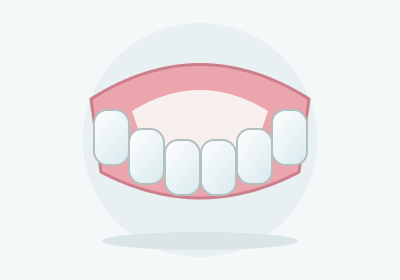
Illustration of removable dentures
Dentures
4–6 visits over 4–8 weeks
Only if extractions are needed
Appointment
30–60 minutes per visit
Visits
4–6 visits over 4–8 weeks
Anaesthesia
Only if extractions are needed
Recovery
2–4 weeks to adapt
How long it lasts
5–10 years before relining or remaking

Overview

What are dentures?

A denture is a removable appliance carrying replacement teeth on a gum-coloured base. It restores chewing, speech and the facial support that is lost when teeth go.

It is fabricated over several visits — impression, bite registration, a try-in. You approve before it is finished, only then it is delivered. The try-in matters: it is where you see the teeth before they are set.

Suitability

Is it right for you?

Dentures may suit you if

  • You have lost several teeth, or all of them in one or both the arches
  • You are not a candidate for implants, or would prefer not to have surgery
  • Your existing denture is loose, sore or has stopped fitting
  • Your face has begun to look sunken from tooth loss

Your other options

  • An implant-supported overdenture, the middle ground: removable, but clipped down
  • A fixed bridge, where enough natural teeth remain to carry it

If one of these suits you better than dentures, we will say so at your consultation — including when the right answer is to do nothing for now.

Options

Denture options we offer

  • Complete dentures

    A full arch where no natural teeth remain. Held by suction and the shape of the ridge.

  • Partial dentures

    Fills gaps while your remaining natural teeth stay. Clasped to natural teeth for support.

  • Flexible dentures

    A softer nylon base with no metal clasps — more comfortable and more discreet, though harder to reline.

  • Implant-supported overdenture

    Clips onto two to four implants.

  • Immediate dentures

    Fitted the same day teeth are removed, so you are never without teeth. They need relining as the gum shrinks.

Step by step

What actually happens

  1. Step 1: Assessment

    Visit 1

    We examine the ridges and any remaining teeth, and discuss whether a conventional or implant-supported denture is right for you.

  2. Step 2: Impressions

    Visit 2

    A first impression, then a precise second one in a custom tray.

  3. Step 3: Bite registration

    Visit 3

    We record how your jaws meet and choose tooth shade and shape with you.

  4. Step 4: Try-in

    Visit 4

    The teeth are set in wax so you can see and approve the look before it is finished. Speak up here — changes are easy now and hard later.

  5. Step 5: Fit and adjust

    Visit 5+

    The finished denture is fitted. May need two or three adjustment visits for sore spots; this is normal, not a fault.

Benefits

Why it is worth doing

  • Restores chewing and clearer speech

  • Supports the lips and cheeks, addressing the sunken look of tooth loss

  • No surgery for conventional dentures

  • Can be relined or added to as things change

After treatment

Recovery, aftercare and risks

Recovery and aftercare

  • Take them out at night — the gums need rest, and sleeping in dentures raises the risk of fungal infection
  • Clean them daily with a denture brush and soap, not toothpaste, which is abrasive
  • Soak overnight in a denture solution or plain water — never hot water, which warps the base
  • Rinse after meals
  • Come back for sore-spot adjustments rather than trimming them yourself
  • Annual reviews — the ridge shrinks and the fit changes

What can go wrong

  • Lower complete dentures are considerably less stable than upper ones — this is anatomy, not workmanship, and no denture technique fully solves it
  • Sore spots in the first weeks are expected and need adjustment visits
  • The jaw ridge continues to shrink under a denture, so the fit loosens over years and relining or remaking is eventually needed
  • Speech and eating take weeks of practice; hard and sticky food may stay difficult
  • Partial denture clasps can put strain on the teeth they grip
  • Denture stomatitis, a fungal inflammation, develops if they are worn overnight and not cleaned

Who will treat you

Our clinical lead

Dr. G. Vijay Srinivas

MDS · MNDC (New Zealand) · MADC (Australia) · PGDAI (CIIOMFI, France) · Fellow ICOI (USA)

Dr. G. Vijay Srinivas is an Oral & Maxillofacial Pathologist and Implant Dentistry practitioner with more than 35 years of clinical experience, and the founder of AP Superspeciality Dental Hospitals.

Full profile

Where

Hospitals offering dentures

  • Banjara Hills Elite

    On Road No. 2, in Park View Enclave — third floor of the HSR Eden building.
  • Banjara Hills

    Beside Centre for Sight Eye Hospital on Road No. 2.
  • Suchitra 'X' Roads

    Beside Suchitra Academy, fifth floor of Jain Friends Square on Suchitra Road.
  • RTC 'X' Roads

    At RTC 'X' Roads in Vivek Nagar, off the Chikkadpally main road.
  • Vijaynagar Colony

    Opposite the Hockey Ground on Vijay Nagar Colony Road, near Masab Tank.

Questions

Dentures — your questions

Still have questions?Call or message us — we reply quickly.Call a hospitalWhatsApp

Two to four weeks for most people, sometimes longer for a first lower denture. Expect increased saliva, some difficulty with speech and a real learning curve with eating. Start with soft food cut small, chew on both sides at once, and give it time.

Upper dentures generally hold well by suction. Lower complete dentures are honestly the hard case — the tongue and floor of the mouth constantly unseat them, and this is anatomy rather than poor fit. If stability matters to you, two implants with an overdenture clip transform the lower denture, and it is worth discussing.

No. The gums need several hours a day without pressure, and dentures worn round the clock significantly raise the risk of denture stomatitis, a fungal inflammation. Take them out overnight and soak them.

Usually every five to ten years. The denture itself does not wear out so much as the jaw underneath it changes — the ridge resorbs steadily once teeth are gone, so a denture that fitted well at year one is loose by year six. Relining buys time; eventually it needs remaking.

An implant overdenture sits between the two and is often the sensible compromise.

Book about dentures

Prefer to talk? Call 888 605 2345 or find your nearest hospital.

Book your appointment

Message us on WhatsApp or call your nearest hospital and we will find you a time.