
Skip to content
Tooth replacement

Dental Implants in Hyderabad

A replacement root and crown that stands on its own, without touching the teeth beside it.

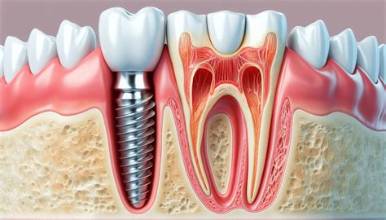
Illustration of an implant replacing a tooth root with a titanium post and crown
Dental ImplantsTooth replacement
2–4 visits over 3–6 months
Local anaesthetic; sedation available
Appointment
45–90 minutes for implant placement
Visits
2–4 visits over 3–6 months
Anaesthesia
Local anaesthetic; sedation available
Recovery
Back to routine in 1–2 days; healing over 3–6 months
How long it lasts
Typically 15–25 years with good care and attending regular recall visits

Overview

What are dental implants?

A dental implant is a small titanium post placed into the jawbone to take the place of a missing tooth's root. Over the following months the bone grows onto its surface — a process called osseointegration — which is what gives the implant, its stability.

Once it has fused, an abutment and a custom crown are fitted on top. The result stands on its own: unlike a bridge, it does not need the healthy teeth on either side to be trimmed down to carry it.

Suitability

Is it right for you?

You may be a candidate if

  • You have one or more missing teeth, or a tooth that cannot be saved
  • You wear a denture that moves, clicks or has become uncomfortable
  • You would rather not have healthy neighbouring teeth prepared for a bridge
  • Your gums are healthy and your jawbone has enough volume — or can be grafted
  • You do not smoke, or are willing to stop during the healing phase

Your other options

  • Leaving the gap, which is reasonable for some back teeth but allows the opposing tooth to over-erupt

If one of these suits you better than dental implants, we will say so at your consultation — including when the right answer is to do nothing for now.

Options

Implant options we offer

  • Single tooth implant

    One post, one crown. Replaces an individual tooth without involving its neighbours.

  • Multiple implants

    Two or more posts carrying a bridge, for several missing teeth in a row.

  • All-on-4 / All-on-6

    A full arch of fixed teeth carried on four to six implants — an alternative to a removable denture.

  • Immediate placement

    The implant is placed at the same visit as the extraction, where the bone and gum condition allow it. Not every case qualifies.

  • Bone grafting & sinus lift

    Where bone volume is insufficient, grafting rebuilds the site first. This adds months to the timeline.

Step by step

What actually happens

  1. Step 1: Consultation and CBCT scan

    Visit 1

    A 3D cone-beam scan shows us the exact bone height, width and the position of the nerve. We plan the implant position on the scan before anything is placed.

  2. Step 2: Implant placement

    Visit 2

    The post is placed under local anaesthetic — most patients describe the sensation as pressure rather than pain. It takes about an hour for a single implant.

  3. Step 3: Healing and osseointegration

    3–6 months

    The bone fuses to the implant surface. You wear a temporary tooth in the meantime if the gap is visible. This phase cannot be rushed — it is what makes the implant last.

  4. Step 4: Abutment and impression

    Visit 3

    Once integration is confirmed, we fit the connector and take a digital scan for the crown.

  5. Step 5: Crown fitting

    Visit 4

    Your custom crown is fitted, the bite checked and adjusted. You will be able to eat on it.

Benefits

Why it is worth doing

  • Stands independently — the teeth on either side are left untouched

  • Transmits bite force into the jaw, which helps limit the bone loss that follows a missing tooth

  • Does not come out at night, and does not need adhesive

  • Cleaned with a brush and floss like a natural tooth

  • Individual implants can be replaced without redoing the whole arch

After treatment

Recovery, aftercare and risks

Recovery and aftercare

  • Cold compress and soft food for the first 48 hours
  • Avoid smoking during healing — it is the single biggest cause of implant failure
  • Brush and floss around the implant exactly as you would a natural tooth
  • No hard or crusty food on the site until we confirm integration
  • Six-monthly reviews, for checking the bone level around the post

What can go wrong

  • Implants fail in a small proportion of cases — most often in smokers, uncontrolled diabetics, or where the bone was marginal to begin with
  • Peri-implantitis, an inflammation of the gum and bone around the post, can develop if plaque is not controlled
  • Lower-jaw placement carries a small risk of nerve irritation causing temporary numbness at lower lip or chin regions; the CBCT scan is how we plan around it
  • Bruising, swelling and mild soreness for several days after placement are normal, not complications

Who will treat you

Our clinical lead

Dr. G. Vijay Srinivas

MDS · MNDC (New Zealand) · MADC (Australia) · PGDAI (CIIOMFI, France) · Fellow ICOI (USA)

Dr. G. Vijay Srinivas is an Oral & Maxillofacial Pathologist and Implant Dentistry practitioner with more than 35 years of clinical experience, and the founder of AP Superspeciality Dental Hospitals.

Full profile

Where

Hospitals offering dental implants

  • Banjara Hills Elite

    On Road No. 2, in Park View Enclave — third floor of the HSR Eden building.
  • Banjara Hills

    Beside Centre for Sight Eye Hospital on Road No. 2.
  • Suchitra 'X' Roads

    Beside Suchitra Academy, fifth floor of Jain Friends Square on Suchitra Road.
  • RTC 'X' Roads

    At RTC 'X' Roads in Vivek Nagar, off the Chikkadpally main road.
  • Vijaynagar Colony

    Opposite the Hockey Ground on Vijay Nagar Colony Road, near Masab Tank.

Complex surgical cases — full-mouth rehabilitation, zygomatic implants, cases needing sedation — are carried out at our Banjara Hills Elite hospital. If your case needs that team, we will move you there rather than compromise on it.

Questions

Dental Implants — your questions

Still have questions?Call or message us — we reply quickly.Call a hospitalWhatsApp

The placement itself is done under local anaesthetic, so you should feel pressure and movement but not pain. Afterwards, most patients report soreness comparable to an extraction for two to three days, managed with ordinary painkillers. We will not tell you it is painless — we will tell you exactly what to expect.

Usually three to six months from placement to final crown, because the bone needs that time to fuse to the implant. If a graft is needed, add three to six months more. Immediate-loading cases are quicker but only a minority of patients qualify.

With good hygiene and regular reviews, implants commonly last 15 to 25 years and often longer. The crown on top usually needs replacing before the implant does. Nothing in dentistry is permanent, and anyone promising you a lifetime guarantee is overselling.

There is no upper age limit. What matters is bone volume and general health, not birth date — we place implants routinely for patients in their seventies and eighties. Uncontrolled diabetes, smoking and certain bone medications matter far more than age.

Not usually in one, but two is realistic: placement on the first visit, then the crown three to six months later. Many of our International patients have the crown stage timed to a planned trip home. We can also do the first consultation by video before you fly. See our International patients page for how we schedule this.

Book about dental implants

Prefer to talk? Call 888 605 2345 or find your nearest hospital.

Book your appointment

Message us on WhatsApp or call your nearest hospital and we will find you a time.