
Skip to content

Tooth Extraction in Hyderabad

Removing a tooth that cannot be saved — and planning what replaces it.

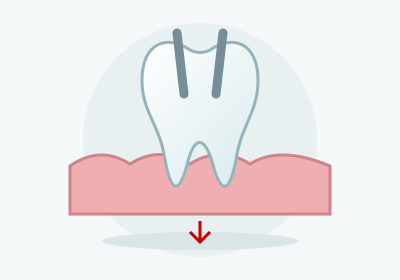
Illustration of a tooth being lifted from the gum
Tooth Extraction
Usually 1 visit
Local anaesthetic; sedation available
Appointment
15–45 minutes
Visits
Usually 1 visit
Anaesthesia
Local anaesthetic; sedation available
Recovery
3–7 days; socket closes over 3–4 weeks
How long it lasts
Permanent — plan the replacement before you extract

Overview

What is tooth extraction?

An extraction is the removal of a tooth that cannot reasonably be saved, or that is causing problems by being where it is. It is the last resort, not the first — a natural tooth is worth keeping wherever the effort is justified.

Simple extractions loosen and lift the tooth out. Surgical extractions — impacted wisdom teeth, fractured roots — involve raising the gum and sometimes sectioning the tooth. Both are done under local anaesthetic.

The decision that matters is not really the extraction. It is what replaces the gap, and that is worth deciding before the tooth comes out rather than after.

Suitability

Is it right for you?

A tooth may need removing if

  • Decay has destroyed too much of it to restore
  • It is split or fractured below the gum line
  • Gum disease has destroyed the bone holding it in
  • A wisdom tooth is impacted, repeatedly infected, or damaging the tooth in front
  • Orthodontic treatment needs space created
  • A baby tooth is blocking the adult tooth behind it
  • A root canal has failed and cannot be re-treated

Your other options

  • Root canal treatment and a crown, which keeps the tooth and is usually simpler overall than extraction plus implant
  • Gum treatment, where the tooth is loose from bone loss but still salvageable
  • A large restoration or a crown for a heavily broken-down tooth
  • Monitoring an impacted wisdom tooth that is not causing symptoms — not every one needs removing

If one of these suits you better than tooth extraction, we will say so at your consultation — including when the right answer is to do nothing for now.

Options

Types of extraction we perform

  • Simple extraction

    For a tooth fully visible in the mouth. Loosened and lifted out — usually 15 minutes.

  • Surgical extraction

    For roots below the gum or teeth that will not come out whole. The gum is raised and the tooth sectioned.

  • Wisdom tooth removal

    Including impacted teeth, planned on an OPG or CBCT to map the nerve position before we start.

  • Extraction with socket preservation

    A graft placed in the socket to limit bone shrinkage, if an implant is planned later. Worth discussing before the extraction, not after.

  • Extraction with immediate implant

    Where bone and gum condition allow, the implant goes in at the same visit. Not every case qualifies.

Step by step

What actually happens

  1. Step 1: Assessment and X-ray

    Visit 1

    We confirm the tooth genuinely cannot be saved, and map the root shape and nerve position. For lower wisdom teeth a CBCT is sometimes needed.

  2. Step 2: Planning the gap

    Before extraction

    We discuss what will replace the tooth — implant, bridge, denture, or nothing — because it affects whether we preserve the socket.

  3. Step 3: Anaesthetic

    Day of

    The area is fully numbed. You will feel firm pressure and hear noise, but not pain. Tell us if you feel anything sharp.

  4. Step 4: Removal

    15–45 minutes

    The tooth is loosened and removed. Surgical cases involve raising the gum and sometimes stitches.

  5. Step 5: Haemostasis and instructions

    10 minutes

    You bite on gauze until bleeding stops, and we go through the aftercare properly before you leave.

Benefits

Why it is worth doing

  • Ends the pain and infection from a tooth that cannot be saved

  • Prevents infection spreading to the bone and surrounding tissue

  • Removes a wisdom tooth that is damaging the healthy tooth in front of it

  • Creates space where orthodontic treatment requires it

  • Socket preservation at the same visit protects the site for a future implant

After treatment

Recovery, aftercare and risks

Recovery and aftercare

  • Bite firmly on the gauze for 30–45 minutes. Do not keep checking it — that restarts the bleeding
  • Do NOT rinse, spit or use a straw for 24 hours. Suction dislodges the clot and causes dry socket, which is genuinely very painful
  • Do not smoke for at least 72 hours. Smoking is the single biggest cause of dry socket
  • Cold compress on the cheek — 20 minutes on, 20 off — for the first day
  • Soft, cool food. Nothing hot, hard, spicy or crunchy for a couple of days
  • From day two, gentle warm salt-water rinses after meals
  • Brush your other teeth normally; avoid the socket itself for a few days
  • Call us if bleeding does not stop, if pain worsens after day three, or if you get a fever

What can go wrong

  • Dry socket — where the clot is lost and the bone is exposed — occurs in a small percentage of cases and is severely painful. Smoking, rinsing early and using straws are the main causes, and all are avoidable
  • Lower wisdom teeth sit near a nerve; removing them carries a small risk of lip or tongue numbness, usually temporary but occasionally lasting
  • Bleeding, swelling and bruising for several days is expected, not a complication
  • Infection of the socket, which is treatable
  • The jawbone shrinks where a tooth is removed, which can make a later implant more complex — this is why socket preservation is worth discussing beforehand
  • Neighbouring teeth drift and the opposing tooth over-erupts into the gap over years
  • Upper back extractions sit near the sinus and can open a small communication with it
  • Extraction is irreversible. A tooth removed does not come back

Who will treat you

Our clinical lead

Dr. G. Vijay Srinivas

MDS · MNDC (New Zealand) · MADC (Australia) · PGDAI (CIIOMFI, France) · Fellow ICOI (USA)

Dr. G. Vijay Srinivas is an Oral & Maxillofacial Pathologist and Implant Dentistry practitioner with more than 35 years of clinical experience, and the founder of AP Superspeciality Dental Hospitals.

Full profile

Where

Hospitals offering tooth extraction

  • Banjara Hills Elite

    On Road No. 2, in Park View Enclave — third floor of the HSR Eden building.
  • Banjara Hills

    Beside Centre for Sight Eye Hospital on Road No. 2.
  • Suchitra 'X' Roads

    Beside Suchitra Academy, fifth floor of Jain Friends Square on Suchitra Road.
  • RTC 'X' Roads

    At RTC 'X' Roads in Vivek Nagar, off the Chikkadpally main road.
  • Vijaynagar Colony

    Opposite the Hockey Ground on Vijay Nagar Colony Road, near Masab Tank.

Complex surgical cases — full-mouth rehabilitation, zygomatic implants, cases needing sedation — are carried out at our Banjara Hills Elite hospital. If your case needs that team, we will move you there rather than compromise on it.

Questions

Tooth Extraction — your questions

Still have questions?Call or message us — we reply quickly.Call a hospitalWhatsApp

During the extraction, no — the area is fully numbed and you should feel firm pressure and hear some noise, but not pain. If you feel anything sharp, tell us and we will add more anaesthetic. Afterwards, expect soreness and swelling for three to five days, which ordinary painkillers manage. Pain that gets worse after day three is not normal — call us, as it usually means dry socket.

The blood clot that forms in the socket is the dressing over exposed bone. If it is dislodged, the bone is left bare and it is intensely painful, typically starting around day three. Avoiding it is straightforward: no rinsing, spitting or straws for 24 hours, and no smoking for at least 72. Smokers get dry socket several times more often than non-smokers.

No, and this is over-treated. A wisdom tooth that is fully through, cleanable and not causing problems can usually be left alone. We recommend removal when it is impacted, repeatedly infected, decayed, or damaging the tooth in front. We will show you the X-ray and explain why rather than remove it as a matter of routine.

Usually two to three months, once the socket has healed — though in selected cases an implant can go in at the same visit as the extraction. The important thing is to decide before the extraction, not after: if an implant is likely, a socket preservation graft at the same appointment limits the bone shrinkage and makes the implant simpler later.

Most people are back to normal in three to seven days. Swelling peaks around day two and then settles. The socket itself closes over three to four weeks, and the bone underneath continues remodelling for a few months. Surgical and wisdom tooth extractions sit at the longer end.

Book about tooth extraction

Prefer to talk? Call 888 605 2345 or find your nearest hospital.

Book your appointment

Message us on WhatsApp or call your nearest hospital and we will find you a time.